Support Child Rights for a Better Future of Gen-Next
To support child rights in India, our Organization, Hindrise Foundation has taken multiple steps. Hindrise Foundation, social welfare NGO has played an exemplary role while confronting all odds on the way of supporting child rights. The vision of Hindrise Foundation is to uplift the sustenance conditions of less privileged children battling against the cruelties existing in the society.
Around the globe, child rights are the topic of concern for every country. Each child, regardless of his/her age, race, gender, wealth, or birthplace, deserves not just to live, but to live with dignity. Yet there are millions of children whose basic rights are denied and their childhoods are snatched away from them by multiple ways of abuse, exploitation, slavery, sexual harassmnet, etc. To support child rights we must first get into it’s basic.
Many violations and atrocities children face are a consequence of exploitative practices and education gaps in developed and developing communities. However, poverty, exploitation, and violence are not inevitable. With enlightened support from governments, civil society, NGO’s and religious groups, affected children can flourish and reach their highest potential. NGO’s all around the country can help to support child rights and save them from unseen atrocities.
Despite achieving significant progress in addressing poverty, access to education, and HIV levels in India, the results have been uneven and unaddressed. India’s children continued to face some of the harshest conditions anywhere globally, with high malnutrition rates or (stunting), child labor, forced begging, and childhood illnesses such as diarrheal disease. To just support child rights are not enough, we must fight all odds to get it executed.
Child Rights- A Brief Overview
Children’s rights are fundamental human rights that recognize the unique needs for care and minors’ protection — usually defined as anyone younger than 18.
International agreements on child rights say that all children should grow up in the spirit of peace, dignity, tolerance, freedom, equality, and solidarity. In this ideal world, these tenets would direct each country’s education systems, health, law, and social services. Unfortunately, this is not always the case.
Children are often abandoned. They, at times, do not get a chance to step into a school. Children are left to fend for themselves on the streets. They suffer from multiple violence and do not have access to even primary healthcare & are subjected to cruelties and inhumane treatments daily. They are children, all innocent, young, and beautiful – deprived of their rights, which need nurturing and proper care. To support child rights, we must start by nurturing them.
In the history of human rights, children’s rights are the most ratified ones. The UNCR defines Child Rights as the minimum entitlements & freedoms that should be afforded to every child below 18 regardless of race, national origin, color, gender, language, religion, opinions, origin, wealth, birth status, disability, etc.
These rights encompass freedom of children & their civil rights, family environment, basic healthcare and welfare, primary education, cultural activities, and special protection measures. The UNCRC outlines the fundamental human rights for children in four broad categories that suitably cover all the aspects, i.e., civil, political, social, economic, and cultural rights of every child. As an NGO, to support child rights, we are giving our best to comply with all basic provisions for their protection in the long run. To support child rights should be the Nation’s Mantra to achieve the goals.
Status of Child’s Rights in India
More than 472 million children in India are under 18 years, representing 39% of the country’s total population. A large percentage, 29% of that figure, constitutes children between 0 and 6 years. Also, 73% of India’s children are living in underprivileged areas often have restricted access to fundamental/ basic needs such as nutrition, access to healthcare, education, & protection. The majority of children living in rural areas often experience negative repressions in children accessing basic fundamental rights. India’s commission for the protection of child’s rights has impacted promoting children’s rights in India. It is notably eliminating child labor, protecting children and adolescents.
The commission’s mandate was “to ensure all Laws, Policies, Programmes, & Administrative Mechanisms are in line with the Child Rights perspectives as enshrined in India’s constitution and the UN Convention on the Rights of the Child,” adopted in 1989. In India, it is clear that promoting and protecting children’s rights is a government priority enshrined within India’s constitution and protected in legislation. Despite this, children in India continue to face challenges in attaining these rights, particularly those related to education, forced labor, and child marriage. Given that children make up 39% of India’s 1.33 billion population, these children’s rights must be met and recognized.
Realizing the strength of children in India, we should take all possible steps to support child rights and protect them from all atrocities. As an NGO, we are adamant about securing child rights for a better tomorrow and forever.
Why is it Important to Support Child Rights?
There are multiple reasons to support child rights in the current scenario; it includes:
- Children are also individuals.
Children are often treated differently. Children are considered neither the possessions of parents nor of the State. They are the people-in-the-making and possess equal status as members of the other humans and their families. Therefore, they deserve equal rights and opportunities like other human beings. We, as an NGO, are striving to support child rights.
- Children start their life as totally dependent beings.
Children must rely on the adults for their nurture and guidance they need to grow towards independence. Such care and nurture are ideally found from adults in children’s families. Still, when primary adult caregivers cannot meet children’s needs, it is up to the State and NGOs like us as the primary duty bearer to find an alternative in the child’s best interests. Also, the duty shifts from their families to us to support Child Rights.
- The actions, or flaws, of government impact children more strongly than any other section in society
The Government’s policies and regulations directly impact the lives of children. Children are the new face of India. Hence, all proper measures to preserve their rights and interests are taken. Practically every portion of government policy, starting from education to public health, affects children to some extent. Short-sighted policymaking, which fails to consider children, imposes a negative impact on the future of Indian society. Hence, a proper framework is required to support child rights.
Let’s Come Together and Stand for Child Rights
- Children’s views/opinions must be heard & considered in the political process.
Often, children generally do not vote and do not traditionally take part in political processes. Without special attention to children’s opinions as expressed at home, schools, local communities, and even Government policymaking – children’s views go unheard on the many essential issues that affect them throughout the future. To support child rights, having their opinion intact is also must.
- Changes in society patterns are having a disproportionate impact on children.
Any major or minor changes in the societal pattern have a direct impact on children. The transformation of family structure, globalization, climate change, digitalization, migration, changing employment patterns, and a shrinking social welfare net in many countries has stringently impacted children’s lives. The impact of these results can be particularly devastating in situations of armed conflict & other unseen events.
- The healthy upbringing of children is crucial to the development of any society.
Since children are in a development stage, they are more vulnerable to poverty, health issues, nutritious food, safe drinking water, shelter, and environmental pollution. The aftereffects of the disease, malnutrition, and poverty threaten the child’s future and result in the deterioration of the society they live in. Hence, a need arises to support child rights in their growing stage.
- The costs of failing its children are enormous to society
Social research shows that children’s earliest experiences significantly influence their future development. The course of their action determines their contribution, or cost, to society throughout their lives. Hence, proper measures are taken from the Government’s side and by NGOs to support child rights.
Role of Constitution of India to Support Child Rights
The Indian Constitution secures rights to children just as citizens of the country, and in keeping with their special status, the State has enacted special laws. The Constitution of India, promulgated in 1950, encompasses most rights mentioned in the UN Convention on the Rights of Child as Fundamental Rights & Directive Principles of State Policy. Over many years, individuals and public interest groups, NGOs have approached the apex court for restitution of fundamental rights, including child rights.
The DPSP articulates social & economic rights that have been declared to be “fundamental in the country’s governance and the duty of the state to apply … in making laws” (Article 37). The government is flexible in undertaking appropriate legislative and administrative measures to ensure children’s rights; no court can make the government provide them, as these are essentially directives. These directives enabled the judiciary to give some landmark judgments promoting child’s rights, leading to several Constitutional Amendments as is in the 86th Amendment of the Constitution that launched the Right to Elementary Education as a fundamental right of children.
Constitutional provisions that Guarantee rights that are explicitly meant for the child include:
- (Article 21-A)Right to free & compulsory education for children belonging between the 6-14 year age group.
- Article 24- Right to protection from any hazardous employment till the age of 14 years.
- Article 39(e) -Right to protection from abuse and forced by economic necessity to enter into dangerous employments unsuited to their age.
- Article 39(f) – Right to equal opportunities and facilities to grow in a healthy manner and conditions of freedom & dignified life and guaranteed protection of childhood & youth against exploitation and moral and material abandonment.
- Article-45 Right to early childhood care and education to all children until they complete six years of age.
Rights of Children
Children also have some rights as equal citizens of India, just as any other adult of India:
- Article-14 Right to equality.
- Article- 15 Right against any discrimination.
- Article-21 Right to life and personal liberty and due process of law.
- Article-23 Right of protection from being trafficked and be forced into bonded labor.
- Article-29 Right of minorities for the protection of their interests.
- Article-46 Right of weaker sections of the people to be protected from social injustice and all forms of exploitation.
- Article-47 Right to nutrition and standard of living and improved public health.

Hindrances Lying on the Way to Support Child Rights in India
There are several factors that negatively impact a child’s well-being and development and often deny the child’s right to health and survival, protection, and education. These factors include:
Poverty and Lack of Pure Water
India’s large population is entirely responsible for the slow growth and development of the Nation. Today, in India, many people continue to live in poverty stricken situation. Inequalities between different groups of populations strongly characterize our Nation. Children are mostly affected by poverty and social inequality. One major factor contributing to this poverty is the lack of clean and hygienic water. Water is necessary for consumption and agriculture-related purposes. It struggles against the spread of diseases caused by the absence of sufficient sanitation. These diseases often result in deadly illnesses and deaths among children.
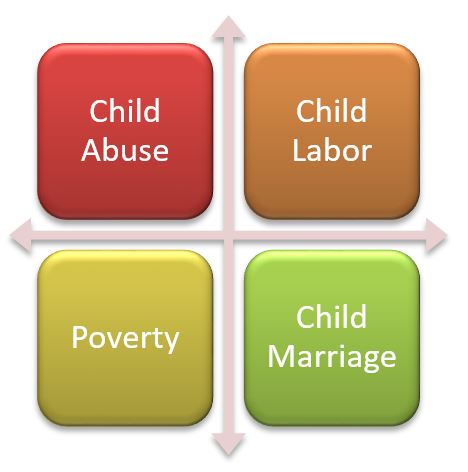
Child Labor and Child Abuse
Recently, India has put efforts into programs to fight against child labor and abuse. Significant factors contribute to the existing problem, i.e., the lack of food, high rate of poverty, and social and economic circumstances. Other contributing factors include the lack of awareness about child labor’s harmful effects and the lack of access to primary and meaningful quality education and skills training. Children forced into labor rather than education is not allowed to prosper physically, intellectually, emotionally, and psychologically. India has one of the world’s youngest populations, yet more than 42.7 million children are out of school.
Child abuse is a dark reality that is highly prevalent in India and adversely impacts children’s health and well-being. Statistics reveal that every 15 minutes, one child is sexually abused. The lack of sanitation and women’s improper safety are leading factors for the increased risk of sexual abuse. The health hazards of child sexual abuse are mental health, physical health, behavioral change, etc. Also, Children experiencing sexual abuse possess a high risk for psychiatric disorders, obsessive-compulsive disorders, and suicidal thoughts. It is a high time that we save and support child rights to preserve their childhood.
Role of Hindrise Foundation
Our NGO, Hindrise Foundation, is actively supporting all children belonging to underprivileged areas and situations. Hindrise Foundation is steadily working to aware members of the society of the rights of children and support child rights. More Rights gives more responsibilities. Responsibilities against child and human rights violation and to protect the dignity and integrity of child Life is our plan. Hindrise is taking this fact into notice that awareness will trickle down to the next generation if the present one is enlightened. To conquer this objective, Hindrise has been organizing Awareness Camps, Nukkad Nataks, Community Outreaches, etc. We believe our hard work shall surely pay off one day.
We do our best to support child rights and well-being. Their protection is our only duty seeing the current scenario. Half of the populations whom we call children are still living in the discriminatory environment of our society. Yet, they are craving for equal opportunities, equal rights, and similar responsibilities. They have been passing from a phase of identity crises. Hindrise is trying their best to empower them financially, socially, culturally, and psychologically.
Our Role in Satiating Hunger
We are uplifting our efforts to mobilize action to end hunger all over India while educational programs and campaigns concerning its devastating effects on underprivileged children. We are adamant about supporting child rights of “Right to Food and drinking water.”We keep our eyes on reducing food wastage and utilizing the remaining food lots in serving the hungry and underfed individuals living in backward communities through our multiple programs. We are proceeding ahead on the trip to equip less privileged children with sustainable hunger solutions hoping that the accessibility of quality-based food in marginalized parts of Indian societies would increase.
Hindrise Foundation advocates ending hunger by joining hands with policy creators, discussing hunger-related issues, and finding out the appropriate source and solutions to support child rights. We are actively assisting the most vulnerable children residing in India. Hindrise Social Welfare Foundation serves life-changing resources like food, potable drinking water, medical assistance, and vocational and educational training to children to support child rights. By consistently working towards the root causes of hunger and analyzing the problems that underprivileged children face, we try to develop desired solutions that would make the situation better.
Our Food drive
To support child rights, Hindrise Foundation is striving to transform the picture of underprivileged children by offering food, water, education, medicines to each household. Our volunteers are the hunger heroes that provide pace to our mission of serving the maximum number of hungry children residing in marginalized facility-less societies.
Since we believe that food is necessary for everyone irrespective of social and economic status, we are rapidly making strides in serving hungry children. With the dedication and wholehearted support shown by our Hindrise members, we can say that our dream to support child rights is inching towards becoming a reality.
Conclusion
In India Often Children are referred as the form of God. But it is a sad truth of the society that often children and women are prone to all kinds of vulnerable situations. All children deserve equality, despite their difference. They are entitled to all of these rights, no matter what race, colour, religion, language, ethnicity, gender or abilities define them. To support child rights should be our motto for lives.
By willing to Support child rights is the gesture for the underprivileged children. The support is lent from the Government, social activists and active NGOs. Their task is to support child rights with all the issues they confront. We should take a collective pledge to support child rights and make their safety our priority.