E-Waste Management in India: Challenges and Strategies
Electronic waste, as known as e-waste, is generated when any electronic or electrical equipment becomes unfit for the intended use or if it has crossed its expiry date. Due to rapid technological advancements and the production of newer electronic equipment, the old ones get easily replaced with new models. It has particularly led to an exponential increase in e-waste in India. People tend to switch to the newer models and trending technologies; also, the lives of products get reduced with time. But the issue is left with e-waste management in India and its challenges.
Consumers are the key to better e-waste management in India. Initiatives such as Extended Producer Responsibility; Design for Environment; (3Rs) Reduce, Reuse, Recycle technology platform for linking the market facilitating the circular economy aim to encourage consumers to correctly dispose of the e-waste, with an increased reuse and recycling rates, and also adopt sustainable consumer habits.
In many developed countries, e-waste management is given high priority. In contrast, in developing countries, it is exacerbated by completely adopting or replicating developed countries’ e-waste management and several related problems, including a lack of investment and technically skilled human resources. In addition, there is a lack of infrastructure and the absence of appropriate legislation, specifically dealing with e-waste. Also, there is an inadequate description of stakeholders’ and institutions‘ roles and responsibilities involved in e-waste management, etc.
What is E-waste?
E-waste poses the huge risk to humans, animals, and the environment. E-waste typically consists of plastics, metals, cathode ray tubes (CRTs), printed cables, circuit boards, and so on. The valuable metals like copper, silver, gold, and platinum can be reused from e-wastes once they are scientifically processed. The presence of toxic substances like liquid crystal, lithium, mercury, nickel, selenium, polychlorinated biphenyls (PCBs), arsenic, barium, brominates flame retardants, cadmium, chrome, cobalt, copper, and lead makes it very hazardous, in case e-waste get dismantled and processed in a crude manner with the rudimentary techniques.
The computers, mainframes, servers, monitors, printers, scanners, compact discs (CDs), copiers, calculators, battery cells, cellular phones, fax machines, transceivers, TVs, medical apparatus, iPods, refrigerators, washing machines, and air conditioners are examples of e-waste when they become unfit for its use. The presence of highly toxic substances and heavy metals like mercury, lead, beryllium, and cadmium pose a significant threat to an environment even in minute quantities.
Challenges for E-waste Management in India
E-waste recycles in India is predominantly an informal sector activity. There are thousands of poor households eking a living from scavenging materials from waste dumps. The common recycling practices for middle-class urban households, particularly for waste paper, plastic, clothing, or metal, is to sell out to small-scale, informal sector buyers often known as ‘kabadiwalas,’ and they further sort and sell these as an input material to artisanal or industrial processors.
E-waste management in India follows a similar pattern. An informal e-waste recycling sector employs thousands of households in urban areas to collect, sort, repair, refurbish, and dismantle disused electrical and electronic products. However, there is a different situation in advanced countries, and there is no concept in India of consumers voluntarily donating the useless electrical and electronic equipment at formal e-waste recycling centers. Also, there is not a concept of consumers paying for disposal of the e-waste they generate.
The heavy reliance on an informal sector for e-waste recycling gives rise to these key challenges, as mention below:
- First, the attempt to impose financial penalties on non-compliance or violation of e-waste handling and processing rules is ineffective.
- Second, broader public knowledge regarding market prices and health safety costs of e-waste recycling is less because less paid workers who do this work do not have proper training.
- Third, despite the massive increase in the volume of e-waste generated every year, there is very little investment by large-scale industrial infrastructure for recovery and recycling.

Poor Infrastructure for the Recycling of E-waste
India has very limited infrastructure capacity for large-scale management of e-waste. There are very few governments approved e-waste recycling centers in the country, which only constitutes about 1/5th of the total amount of e-waste generated each year. The Indian Government offers the co-funded grant scheme that covers between 25% to 50% of the project costs for the e-waste management facilities and building capacity for e-waste businesses. However, the uptake of this scheme has been very limited. In addition, there is also a shortage of formally approved e-waste recycling centers as presently existing centers operate far below their capacity due to poorly organized supply chains between them and the majority of informal sector collectors of e-waste in India.
However, the formal sector recycling is limited to manual sorting and mechanical dismantling of e-waste management in India. At present, there is a lack of industrial e-waste managers with an appropriate environmental controls, which are required for large-scale recovery of precious and base metals. A few emerging Indian companies extract metals from e-waste, but they have limited processing capacity. Most of the e-waste processed by a formal sector is exported from other countries with the necessary large-scale infrastructure for metals extraction. In contrast, the informal sector extracts metals using methods such as open-air incineration and acid leaching, which are hazardous and exacerbate environmental pollution and health risks.
Although the E-waste guidelines provide several technologies for recycling and processing different types and components of e-waste, both the formal and informal sectors have mainly focused on metal recovery and less on the glass, plastics, and ceramics that comprise the significant proportion of e-waste. The recycling of plastic e-waste is much more complicated due to the presence of flame retardants and other persistent organic pollutants.
Lack of Awareness and Financial Incentives
There is the lack of public awareness of e-waste hazards in India, and recycling is, therefore, very low. Most consumers do not know or have less knowledge about the hazardous nature of e-waste components or the penalties for improper disposal. They do not know about e-waste management in India is done by urban municipal or state government agencies.
Several cities have very few dedicated collection depots or formal recycling centres where consumers can voluntarily drop-off the e-waste. The majority of people and urban household consumers used to sell e-waste or get some discount in exchange when they purchase any new electrical or electronic products from small-scale retail shops. Since consumers lack market information about prices for e-waste and various e-waste components, they have few financial incentives for responsibly disposing of their e-waste.
Less Information on E-waste Generation Rates
It is acknowledged that there is a lack of e-waste inventories and all the responsibility placed on the state-wise e-waste inventories on the respective State Pollution Control Boards (SPCBs). The sales data on electronic products is an important input in the estimation of e-waste quantities. It is often available at a national-level aggregation, which making it challenging to produce inventories at the state levels. In addition to domestic generation, the e-waste is imported from developed countries, often illegally.
There is less understanding of a nature and amount of e-waste that gets imported into the country. The systems are required for effective collection, transportation, and processing requires reasonably accurate waste generation knowledge and its composition.
Mismanagement in Market for the End-of-life Products
The inability to reliably source e-waste quantities create economies of scale restricts the entry of private players to set up e-waste management systems in a formal sector. For instance, employing effective recycling technologies for e-waste management in India may require significant upfront capital expenditures, which cannot be justified for private entities in the absence of certainty about sourcing enough quantities of e-waste. Also, these markets suffer from information barriers.
First, the e-waste recycling is a relatively new business; the potential lack of information on cost-effective recycling technologies could be a market barrier. Second, there is low awareness, partly because of the lack of reliable information on e-waste management among consumers, affects markets’ functioning. However, the public policy will play a greater role in enabling better markets for e-waste.
Environmentally Unsustainable Informal Sector Practices
Despite the formal dismantling and recycling sector’s growth, the actual waste processed in the formal sector still very low. Most of these formal facilities are operating below the approved capacities because of inability to source enough waste. The lack of awareness regarding e-waste and the costs of returning the end-of-life equipment to formal collection centres are reducing the willingness of household and institutional consumers to return their waste to the formal sector. Most importantly, through the convenience of household collection and monetary incentives, the informal sector makes this attractive for customers to return their waste, relative to the formal sector, that is yet to invest in robust collection and processing systems.
The informal e-waste sector has provided livelihoods to millions of people, often belonging to the most marginalized groups. On contrary, the sector’s waste management practices pose serious environmental and health hazards to the workers themselves as well as the larger public. It presents a potential moral dilemma for public policy, and the sustained success of any e-waste management in India will hinge to resolve this dilemma.
Inadequate Regulatory Design and Enforcement
The mandatory take-back system for producers, without accompanying collection targets as no incentives to take responsibility and therefore induced little improvements in e-waste management practices. Certain amendments were proposed, which provided more regulatory certainty by specifying gradual and increasingly stricter collection targets. However, the regulatory design places a significant burden on the already ill-equipped regulatory agencies. The regulators must review the EPR plan submitted by the producers, grant authorization, and enforce the EPR plan’s provisions.
The regulations must also specify, elaborate standards and processes for other entities for dismantlers, collectors, recyclers, and bulk consumers and required the agencies to enforce compliance with specific standards. The regulatory authorities must capture benefit from poor enforcement, lack of transparency, unwillingness to publicly share information on compliance and regulatory actions. It has long afflicted environmental regulatory enforcement in India, and e-waste regulations are no exception. It poses the significant public policy challenge to the future of e-waste management in India.
Improvement of E-waste Management in India
There are various ways of improving e-waste management in India. However, there are five key components that can be linked together for improving e-waste management in India in a summarised way. It is discussed as below:
Providing Market Information about E-waste Prices
It is a well-established market for e-waste within and between informal and formal sector operators. However, the prices for e-waste & its components are not widely known or publicized among urban consumers. A consolidated price list must be updated on a weekly basis as it would be a powerful market signal for customers who sell the e-waste to local vendors.
The price list has to cover all components of e-waste, starting from bulk e-waste to various glass, metals, plastic, ceramics, and batteries. The information must be presented on dedicated websites by urban municipalities and local newspapers similar to commodity price listings or foreign exchange rates. The price list must reflect the prevailing market demand for e-waste components and enable informal sector collectors to buy and sell e-waste at the fair market prices to private processors or government-approved recycling and dismantling centers.
Incentivizing Formal E-waste Recycling
The Indian Government has introduced a point-based reward system of E-waste Recycling Credits (ERCs) for formal organizations to incentivize them to channel their e-waste through government-approved recycling centers. The E-Waste Rules already classify and code e-waste like laptops, computers, and mobile phones. These categories have to be correlated at different ERC reward levels. Depending on the type of e-waste supplied, organizations must earn the requisite ERCs that can be used to offset energy utility bills. Such an initiative will also provide a strong incentive for informal sector e-waste businesses to formalize the operations and establish supply chain links with approved recycling centers.
The ERCs can be piloted over a 3 to 5 years period to assess the efficacy and to fine-tune for further implementation. The government and industrial sectors in metropolitan cities generate more than 70 % of e-waste. The ERCs can be trialed with a few large industries and government organizations in Mumbai, Delhi, or Bangalore.
The Indian government can also expand formal e-waste recycling capacity by co-funding infrastructure upgrades and processing systems at existing government-approved recycling centers. It can provide co-funding incentives to governments for setting up new recycling units through public-private partnerships with large e-waste companies. State governments could also develop grant schemes for incentivizing small-scale, informal e-waste recycling centers to upgrade the facilities so that they comply with them both environmental and occupational health and safety regulations. States can apply for national urban development funding schemes, which can be used to link the well-established informal sector network of decentralized collection and small recycling units with large-scale industrial recycling centers.
Training and Upskilling Informal Sector Players
The majority of an informal e-waste recycling workforce needs upskilling, particularly for handling and dismantling hazardous materials. It must ensure the work’s environmental and occupational health and safety and link supply to formal sector processors. It is pursued by the Indian government’s National Skill Development Mission. Innovative short courses and training programs can be specially designed for e-waste collectors, handlers, and dismantlers by the Electronics Sector Skill Council’s combined expertise, the Green Jobs Sector Skill Council, and regulatory agencies like the Central and State Pollution Control Boards.
Training and A concerted, nationwide campaign should accompany up skilling of informal sector workers campaign by central and state governments to increase public awareness about the hazards associated with e-waste. The importance of an informal sector in e-waste collection, e-waste dumping, and the locations of formal e-waste collection depots as approved by the government.
Deploying Readily Available and Mature Recycling Technologies
There is an urgent need for deploying mature recycling technologies alongside existing manual techniques to improve the recycling efficiency of the large volumes of e-waste management in India. India has a very large and mature plastics processing sector which can recycle plastic material from e-waste.
The Indian government must promote joint ventures between international and domestic companies for setting up large industrial e-waste recovery plants. These ventures can be funded by a combination of private and public investment.
Developing Innovative Methods & Technologies for Processing New Forms of E-waste
The composition of e-waste is changing rapidly due to the new electronic devices to enter the market. It requires significant investment in research & development for innovative recycling methods and technologies for future-proofing India’s e-waste policies and management. For example, smartphones usage has expanded dramatically in India over the past five years, but any e-waste recycling rules do not yet cover the lithium-ion batteries that power the devices.
Various new battery and materials technologies are being developed for manufacturing the next generation of electronic devices. Thus, the Indian government must promote and fund research that develops innovative, future-oriented technologies for recycling and transforming new e-waste streams into high-value products.
How we can Create Robust E-waste Management in India?
We are constantly evaluating the effectiveness of e-waste regulation and bringing in necessary changes. The government plays an important role in bringing together various stakeholders in a system. We have a few measures that can be considered to move forward.
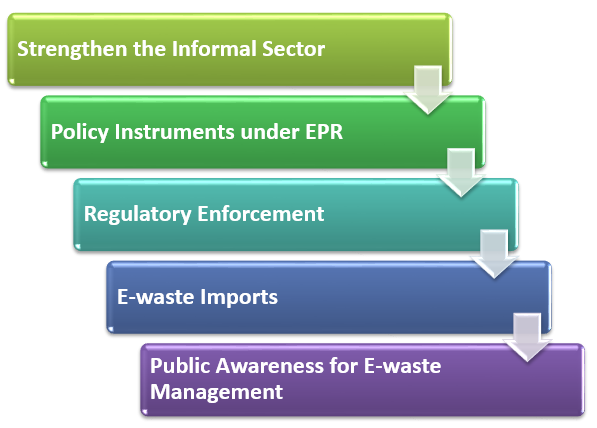
Strengthen the Informal Sector
The first step can be to more explicitly recognize the informal sector as the stakeholder in any future e-waste regime. Addressing the problem of informal sector e-waste practices requires a greater understanding of the sector itself in terms of its incentives and challenges. Engagement with informal sector workers and the groups, in a manner that recognizes the right of their livelihoods, builds trust, and develops an understanding of the problems along with potential solutions, can be an initial step. The government must institute a platform that facilitates consultations among various stakeholders like informal sector workers, NGOs working with the informal sector, third parties, private entities, and registered recyclers, and manufacturers. The forums can be constituted under the Ministry of Environment, Forest and Climate Change at a certain level under the State Department.
Policy Instruments under EPR
The government needs to rethink the policy instruments under the EPR approach. In a presence of the informal sector, it requires strengths in collection logistics. A mandatory take back with collection targets cannot be the ideal instrument. Producer responsibility comes in many varieties other than mandatory take-back.
The economic instruments like advanced recycling fee or advanced disposal fee on every unit of the product sold in the market will relieve the producers of the physical responsibility of collection, and the revenues generated can be used to develop markets for the end-of-the-life or useless products. The revenues that go into a separate fund can be used in several ways.
Some examples are (a) Subsidize consumers to deposit their e-waste at designated centers, (b) Directly fund recyclers (c) Assist informal sector workers in training or skill development or provide a greater social security net to the workers. These decisions can be made within the consultative forum recommended in an informal sector. The problem with economic instruments will be to determine the right fee. Principles of economics will suggest a fee equivalent to the marginal external cost of the end-of-life equipment. While the external costs assessment is difficult in practice, the fee must be high enough to fund the environmentally safe e-waste processing and disposal.
The sufficient fee can also provide incentives for a design for environmental changes in product design that has been one of the main goals of the EPR approach globally. In a long run, to further incentivize changes, the fee can be based on such factors as the ease of recyclability, dismantling, and environmental impact of materials used in a piece of equipment. The policy framework must also focus on the development of indigenous technologies and/or technology transfer to encourage the widespread application of environment-friendly e-waste recycling technologies.
Regulatory Enforcement
Shifting to the economic instruments such as an ADF can also relieve the regulatory burden since the producers need not be regulated anymore. The long experience with tax collection must make it easy to divert the ADF on electronic products to a separate fund.
The State and Central Pollution Control Board will still be required to monitor and enforce compliance with the standards specified for collection centers, dismantlers, recyclers, and PROs. The MoEFCC must make regulatory actions related to e-waste transparent. Regulatory actions like authorizations and their conditions, data on inspections of registered facilities, and inspected facilities’ compliance status should all be made publicly available for scrutiny.
A few SPCBs already publicly provide some of these documents on their websites, but these practices should be institutionalized as part of the country’s regulations. Developing the regularly updated and publicly available inventory of district-wise generation of e-waste quantities by e-waste type (e.g., mobiles, computers, and appliances), waste composition, and flows will also play an important role in enforcement.
E-waste Imports
Under the existing regulations, e-wastes are not allowed to be imported for final disposal but can be imported for reuse and recycling. In an absence of adequate infrastructure in the country for recycling, we must seriously consider banning all kinds of imports. To develop accurate estimates of e-waste, data on imports must be integrated with an e-waste inventory.
Public Awareness for E-waste Management
The current e-waste regulations require the producers to provide, on the websites, information on the impacts of e-waste, appropriate disposal practices, and other issues. There is also a requirement for an awareness campaigns at regular intervals. Many producers have already provided information on the websites, but evidence shows that the overall awareness levels remain low among bulk consumers. Stricter guidelines/regulations to the producers on these awareness campaigns’ frequency and mode might improve the situation.
Alternatively, the producers must be mandated to run these campaigns through grassroots-level organizations working in the area of e-waste. On its part, the government must consider integrating e-waste awareness campaigns with other waste streams such as batteries and municipal solid waste.
Research on the effective messaging techniques and evaluation of information campaigns could also form a part of the role of the government. These awareness efforts must be geared towards achieving safe handling of e-waste and reducing consumption of electronic products in the long run. Overall, public awareness generation initiatives should be based on partnerships and collaboration among various stakeholders.
Role of Hindrise in E-waste Management System
Increasing information campaigns, capacity building, and awareness are critical to promoting environment-friendly e-waste management programs. Increasing efforts are urgently required on the improvement of the current practices like collection schemes and management practices to reduce any illegal trade of e-waste. Reducing the number of hazardous substances in e-products will also positively affect the specific e-waste streams since it will support the prevention process.
Most of the e-waste is recycled in India in unorganized units, which engage a significant number of manpower. Recovery of metals from PCBs by primitive means is the most hazardous act. Proper education, awareness, and, most importantly, alternative cost-effective technology need to be provided to provide better means to those who earn the livelihood from this.
A holistic approach is needed to address the challenges faced by India in e-waste management. The suitable mechanism needs to be evolved to include small units in the unorganized sector and large units in the organized sector into a single value chain. Our approach can be for units in the unorganized sector to concentrate on collecting, dismantling, and segregation, whereas the organized sector could do metal extraction, recycling, and disposal.
Conclusion
E-waste management in India is a great challenge for governments of many developing countries. It is becoming a huge public health issue and is exponentially increasing by the day. It has to be collected separately, treated effectively, and disposed of e-waste. It is also a diversion from conventional landfills and open burning. It is essential to integrate an informal sector with the formal sector. The competent authorities in developing countries like India need to establish mechanisms for handling and treating e-waste safely and sustainable manner.